










APAC CIOOutlook
About UsConferencePartner With Us
  • Technologies
    • Blockchain
      Data Intelligence and Management
      Digital Transformation
      FinTech
      Generative and Agentic AI
      Low Code No Code
      Mobile Application
      Networking
      Robotics
      Storage
      Wireless
  • Industries
    • Automotive
      Aviation
      Banking
      Construction
      E-Commerce
      Food and Beverages
      Healthcare
      Insurance
      Logistics
      Manufacturing
      Retail
      Supply Chain
      Travel and Hospitality
  • Platforms
    • Microsoft
      Salesforce
      SAP
  • Strategic Solutions
    • Business Intelligence
      Contact Center
      Corporate Finance
      CRM
      Cyber Security
      Data Center
      Enterprise Asset Management
      Enterprise Performance Management
      IT Infrastructure and Services
      Managed Services
      Procurement
      Unified Communication
      Workflow
  • Home
  • CXO Insights
  • Leadership Perspectives
  • Innovation Insights
  • Research
  • News
  • Whitepapers
  • CXO Awards
#

Apac CIOOutlook Weekly Brief

×

Be first to read the latest tech news, Industry Leader's Insights, and CIO interviews of medium and large enterprises exclusively from Apac CIOOutlook

Subscribe

loading

THANK YOU FOR SUBSCRIBING

  • Home
Editor's Pick (1 - 4 of 8)
left
The Cambrian Robotic Explosion has Begun

David Tamayo, CIO, DCS Corporation

Is That a Robot in My Factory?

Jim McCoy, CIO, Raytheon

First Steps to Globalizing Your Business

Neil Hampshire, CIO, ModusLink Global Solutions, Inc. [NasdaqGS:MLNK]

A Vision for the Future: Automation, Robotics, and the Smart Factory

Joe Tilli, State Industrial Automation Sales Manager, Lawrence & Hanson

The Rise of Hyper Automation

Erdenezaya Batnasan, Head of IT End-User Support Service Department, Khan Bank

Transforming Business Operations with Robotic Process Automation

Simon So, CMGR, MCMI, Regional Head of Digital Solutions, Richemont Asia Pacifi

Combining Automation with AI to Achieve Human-Like Interaction

Kain Chow, General Manager, Technology & Transformation, New World Development Company Limited

Implementing RPA - 5 Ultimate Prerequisite

Indra Hidayatullah, Data Management & Analytics Division Head, Pt. Bank Tabungan Negara

right

Optimized Networks for an Agile Workplace

Steve Miller, CIO, Steelcase

Tweet
content-image

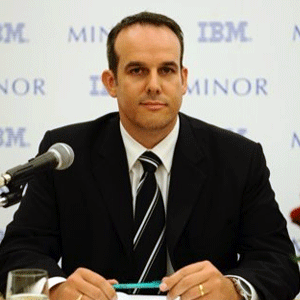
Steve Miller, CIO, Steelcase

Any business hoping to compete in the modern world is devoting extensive resources toward transforming the digital experience for customers and employees. This involves the integration and adoption of new digital tools aimed to make teams more agile. Teams need to be able to collaborate with ease and efficiency. Also, just as important is that the workspace needs to be flexible and accommodating to support people and technologies. But none of this can happen without a strong network.

Traditional office spaces were designed for an era when desktops and landlines kept employees tethered to their desks. Today, employees expect more freedom to work when and where they choose and workplace technologies are attempting to catch up. So what steps should companies take to create an agile working environment?

As companies rethink their office design, IT leaders should join real estate, facilities and design teams early in the planning process. This will ensure plans are logistically feasible and maximize the use of technology. During the planning process, that group should consider ways to optimize its network:

1. Wireless connection. Chances are you already have a wireless network in place but if you don’t, or if your connection is unreliable, it’s time to think about an upgrade. A high-speed Wi-Fi system is an enabler for creativity and collaboration because it allows free movement of workers within the office itself. In the long run, wireless systems provide more flexibility for companies to reconfigure the space, as needed, without rerouting hardwired lines.

2. Network segmentation. Most professionals toggle between multiple devices. From tablets to smartphones, desktops and laptops, employees often utilize hardware provided by their employees plus others they’ve purchased individually. Often, those devices will enter the workplace and digital tools need to have the ability to work together. Network segmentation allows the use of one set of hardware to deliver wireless services to all devices in the space. To do this, create a virtual series of routers within the network to divide the traffic across different paths.

In today’s interconnected business world, network optimization is essential for business, and as technology evolves, these changes allow for greater flexibility and adaptability

The physical hardware will still be limited to one router, but if one path is jeopardized, it won’t bring down the entire network.

3. Data security. As companies prepare to digitize operations, data security cannot be overlooked. Establish profiles for devices operating on your network and account for all employee and visitor users. Also consider identity management. This approach enables organizations to comply with regulations that require businesses to track user activity, like those currently in place in Europe. And, make sure there are guidelines in place that extend specific privileges to users as they utilize personal and professional devices on the network. If you allow the employee to access corporate email from a personal smartphone, for example, ensure they comply with company policies and do not keep this data in personal storage.

4. Telephony. Technology upgrades can be a significant financial investment, so it’s a good idea to make cuts within your existing IT budget when possible. One of the easiest and most common solutions is telephony. The telephone was once the primary tool for instant communication, but today, more than half of Americans have ditched their landline. Nearly 40 percent of the workforce is now comprised of millennials who grew up with instant messenger and social media. There will be 1.75 billion mobile workers globally by 2020, accounting for 42 percent of the global workforce. And, 95 percent of Americans own a mobile phone. Ask yourself: Do your employees still need a desk phone? Increasingly, companies are opting out of land lines and investing in multi-modal communication strategies to accommodate an influx of digital natives into the workplace. And, similar to the Wi-Fi system, foregoing desk phones provides greater ease and flexibility when reconfiguring the office layout—no need to deal with pesky cables.

Often, the biggest hurdle to implementing significant IT upgrades is justifying the cost to traditionalist leaders. In my experience, up-front costs often generate a return on investment in unexpected ways. At my company, Steelcase, we were happy to find some unexpected benefits when we optimized our campus in Grand Rapids, Michigan. Following the upgrades, we experienced a marked increase in employees who felt the space enabled them to better collaborate, work more efficiently and spark creative ideas. An overwhelming 70 percent of our workforce agreed our optimized, digitally-centric space helps our company attract and retain talent. While we did find long-term, hard cost savings associated with optimized space management, we found the impact these changes had on our people, processes and culture were even more valuable.

In today’s interconnected business world, network optimization is essential for practically every business. As technology continues to evolve, these changes will allow for greater flexibility and adaptability. Change is never convenient, but in the long run, your people and your workplace are your greatest assets. When organizations build synergies between people, workspace and technology, they'll be better positioned to drive real business growth.

tag

Data Security

Financial

Digital Experience

Weekly Brief

loading
Featured Issue

I agree We use cookies on this website to enhance your user experience. By clicking any link on this page you are giving your consent for us to set cookies. More info

APAC CIOOutlook
Follow on LinkedIn

About

  • Home
  • About Us
  • Partner With Us

Stay Connected

  • Subscribe
  • Newsletter
  • Sitemap

Contact Us

  • editor@apacciooutlook.com
  • sales@apacciooutlook.com
  • marketing@apacciooutlook.com

Legal

  • Editorial Policy
  • Privacy Policy
  • Terms of Use

© 2026 APAC CIOOutlook. All rights reserved. Headquarteblue in Fort Lauderdale, FL, USA.

This content is copyright protected

However, if you would like to share the information in this article, you may use the link below:

https://intelligent-robotics.apacciooutlook.com/ciospeaks/optimized-networks-for-an-agile-workplace-nwid-5523.html